
In many remote Aboriginal communities, good health begins with something most Australians rarely think about: a working washing machine, hot water and detergent that does not run out. Overcrowding across the Northern Territory is the highest in the country, and in those conditions everyday hygiene breaks down quickly.
The consequences are severe and well documented. Around eight in ten Aboriginal children living in remote NT communities develop skin sores or scabies before their first birthday (Source: https://www.remotelaundries.org.au/remote-laundries/). Repeated, untreated infections can progress to rheumatic heart disease and kidney disease, both serious illnesses that are largely preventable. Australia continues to carry some of the highest rates of rheumatic heart disease in the developed world, almost entirely among First Nations people.
Clean bedding, towels and clothing interrupt that cycle. Washing fabric with detergent, hot water and a hot drying cycle breaks the life cycle of the scabies mite and reduces the bacterial infections that follow. The evidence on the ground is compelling: at Barunga, where the first of these community laundries opened in 2019, scabies cases have reportedly fallen by around 60 per cent since the service began
(Source: https://www.remotelaundries.org.au/proof-our-remote-laundries-project-is-reducing-scabies/).
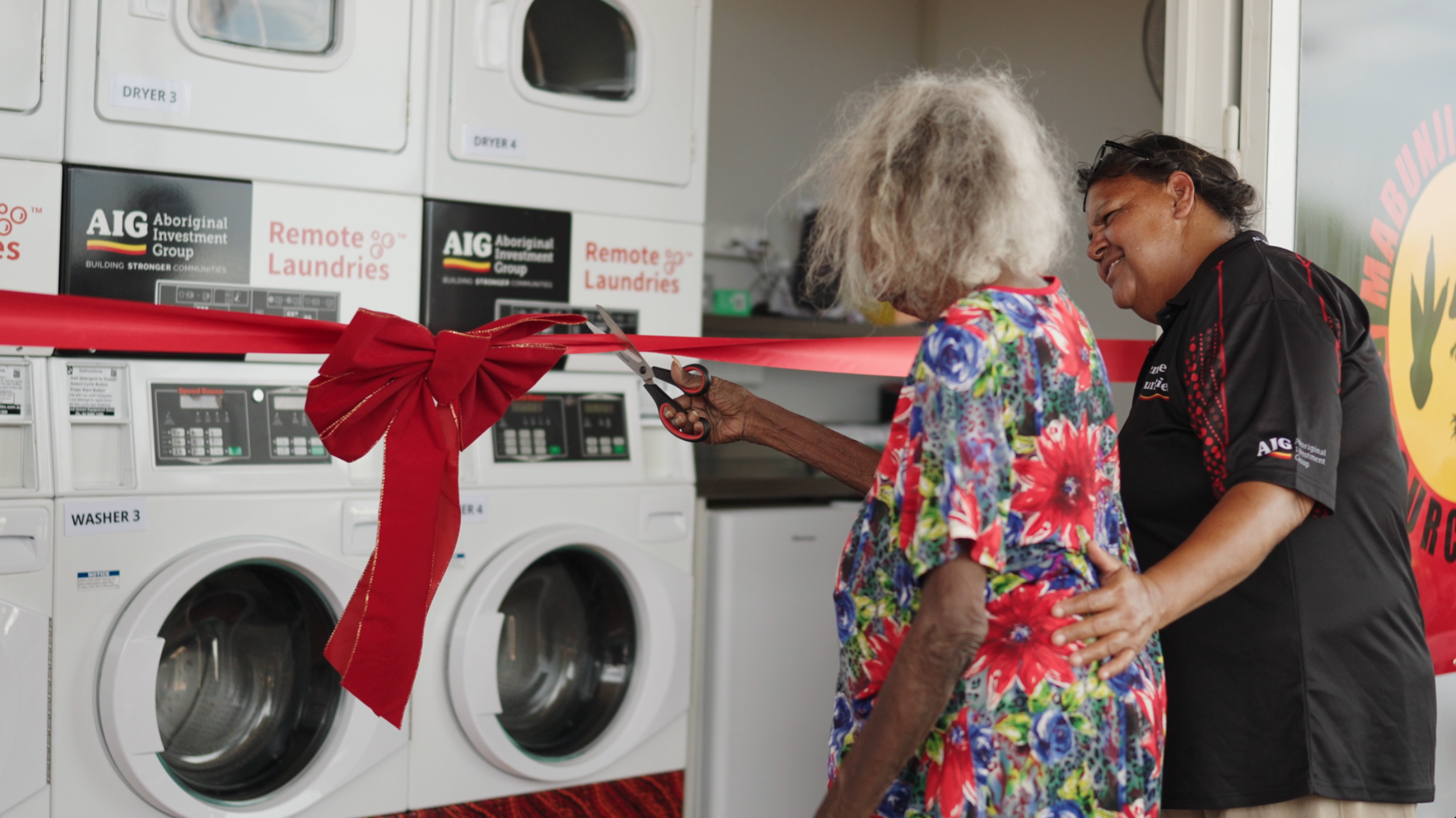
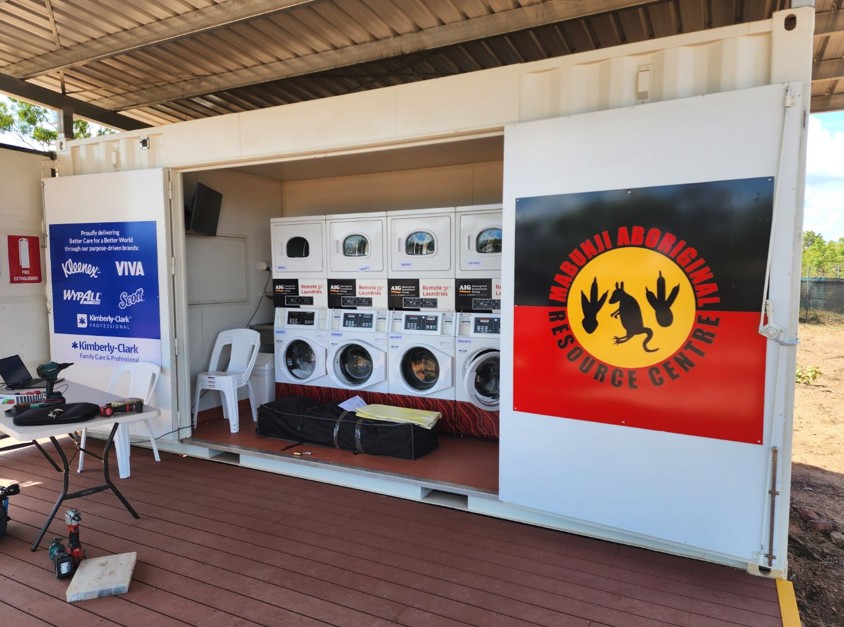
The Remote Laundries Project is a 100 per cent Aboriginal-led initiative developed by the Aboriginal Investment Group (AIG). Each laundry is a permanent facility, built into a custom shipping container fitted with commercial-grade washers and dryers, placed in the heart of a community and free to use year-round. Alongside the practical service, the laundries become hubs for health education, social connection and local employment.
The model works because of how each site is created. AIG co-designs every laundry with Traditional Owners, employs and mentors local community members, and operates in ways that respect cultural protocols. Continuous consultation keeps each service shaped around local needs. That approach shows in the results. Since 2019 the program has delivered more than 73,000 laundry cycles across remote NT communities, with utilisation rates that point to just how essential the service has become. Along the way it has created 117 local jobs, providing meaningful employment and training in places where both are scarce. As Remote Laundries describes its own mission, the program delivers health, social and economic outcomes one wash at a time.
On 25 November 2025, AIG opened its latest laundry in Borroloola, a community on the Territory's southern Gulf coast between Darwin and Alice Springs. Positioned directly across from the local health clinic, the facility was delivered in partnership with the Mabunji Aboriginal Resource Indigenous Corporation, which engaged AIG to design, build and operate it. Months of co-design sessions with the community shaped the final result, so that the service truly reflected what Borroloola families needed.
The early response speaks for itself. In its first fortnight the Borroloola laundry recorded more than 347 wash cycles, and it has since averaged around 30 cycles a day, setting new records across the program. Over a full year it is expected to support more than 1,000 people and wash in excess of 3,000 loads of clothes and linen, run day to day by a local team. Naming that team matters, because they are the service: Tarleiah, Bernice, Jaida and Anita keep the Borroloola laundry running for their community and the surrounding camps.
At Kimberly-Clark Professional, we are proud to support the Borroloola laundry, with AIG, Mabunji and the community firmly in the lead. We have committed to funding the laundry's running costs for its first 12 months of operation, and we donated two pallets of toilet paper for the Borroloola community, easing the cost of an everyday essential that is harder to come by in remote areas. Our aim is to help a community-run service stay viable through the period when that support makes the greatest difference.
That contribution sits within a broader commitment. The Borroloola partnership is a cornerstone action of our first Reconciliation Action Plan as Kimberly-Clark International Family Care & Professional ANZ. It is a Reflect RAP, endorsed by Reconciliation Australia and running from May 2026 to May 2027, and it builds on Kimberly-Clark's longstanding reconciliation work by focusing our efforts where our expertise is most relevant: health, hygiene and dignity.
Our vision through the plan is an Australia where Aboriginal and Torres Strait Islander peoples enjoy equal access to those foundations of thriving communities. Supporting a remote laundry is a direct expression of that vision, and it aligns with Closing the Gap priorities across health and economic participation. For a business that has manufactured essential hygiene products in Australia for close to a century, much of it at our Millicent Mill in South Australia, the reasoning is straightforward. Reliable access to clean clothes and bedding is preventive health infrastructure, sitting upstream of the clinical care that becomes necessary when prevention falls short. By helping keep the Borroloola service running through its first year, we can contribute to long-term, community-led outcomes while leaving the lead role where it belongs.
For those working across healthcare and the systems that supply it, Borroloola is a reminder that some of the most effective health interventions happen well before anyone reaches a clinic. A laundry is a modest piece of equipment, yet in the right setting it can lower the incidence of scabies, reduce the downstream risk of rheumatic heart disease and kidney disease, support school attendance and create lasting local jobs. The benefits reach across health, social and economic life at the same time, which is what makes this kind of infrastructure such a sound investment and partnership.

As the world becomes globalised, the performance and value delivered by our suppliers become more important to the business bottom line.
De-risking your supply chains is a vital but complex process where businesses need to weigh up the potential risk of change.
As the peak body for the Healthcare supply chain profession, one of the increasingly urgent topics is how to attract talent.
Becoming a Sponsor of AHSPO is a valuable way to better engage and connect with healthcare and supply chain community members, increase brand visibility, and demonstrate your commitment to industry excellence.
Get in touch →